Fit the day you have.
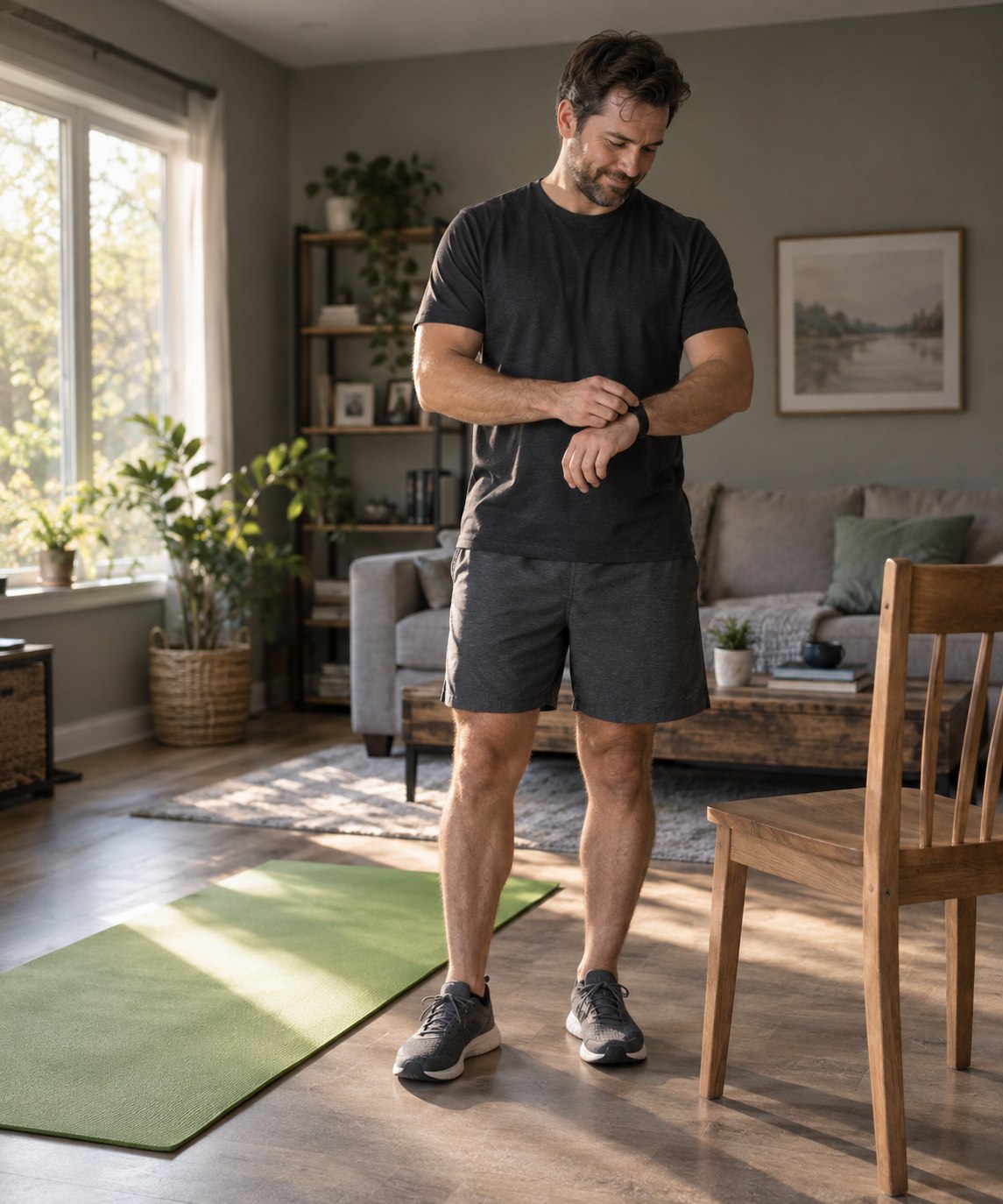
After waking up, before a shower, or while dinner cooks. Choose a moment that works around your shift.
FOR BUSY PARENTS & SHIFT WORKERS
Long shifts. Family time. A schedule that keeps changing. Build a fitness habit that fits the life you actually have.
At home. At your pace. No gym required.
THE BUILT BY WHITE APPROACH
Start with something you can come back to, even when your week looks nothing like the last one.
After waking up, before a shower, or while dinner cooks. Choose a moment that works around your shift.
Use the standing or seated version. Keep movements comfortable and take a break whenever you need one.
Link the routine to something you already do. If a day gets away from you, return at the next suitable opportunity.
FREE · NO SIGN-UP NEEDED
A simple home routine to practise the habit of starting. Choose a version, move comfortably, and leave room for rest.
For minutes 2–4, move for up to 30 seconds, then rest for the remaining time. Use a stable chair without wheels and a clear space.
Walk or march slowly in place. Keep the pace easy and your steps comfortable.
From a stable chair, stand and sit slowly within a comfortable range. Use support if you need it.
Place your hands on a wall around chest height. Gently bend your elbows and press back, keeping the movement small.
Hold a stable support. Slowly lift and lower your heels, using a range that feels comfortable.
Return to gentle movement, then settle into relaxed breathing. Take a moment before carrying on with your day.
Start with three nonconsecutive days and adapt to how you feel. This is a starting habit, rather than a complete exercise programme.
Unsure whether these movements suit you? Ask a health professional who knows your circumstances. Stop if a movement causes pain or you feel unwell.
1. Gentle seated marching · 2. Small seated knee lifts · 3. Gentle seated arm bends · 4. Seated heel raises · 5. Slow movement and relaxed breathing.
For minutes 2–4, move for up to 30 seconds and rest for the remaining time. Keep your feet supported, use a solid chair without wheels, and stay within a comfortable range.
After I ____________________________, I will take a few minutes to move.
Write “moved”, “rest”, or a short note. A rest day is part of your plan.
ANOTHER FREE ROUTINE · NO EQUIPMENT
Bodyweight basics for a daily movement slot. Push, squat, lift your hips, and work your core with a routine that travels with you.
Use a clear, level, non-slip space where you can lie down and move comfortably. A mat or towel is optional; a wall can help with easier push-ups.
30 seconds each: easy marching, shoulder circles, gentle hip hinges, and shallow squats.
Four one-minute stations, repeated three times. Use the work and rest split below.
30 seconds of slow walking or marching, then 30 seconds of relaxed breathing.
45 seconds move + 15 seconds rest at each station. Stop earlier if your form slips; use the remaining time to rest. Repeat the four stations three times.
Set your feet around shoulder-width apart. Send your hips back, bend your knees, and stand tall again. Keep heels grounded and knees following your toes.
Easier: Use a shallow squat. Build up: Lower more slowly while keeping a comfortable range.
Place your hands slightly wider than your shoulders. Keep your body steady as you lower your chest, then press away. Keep breathing and avoid sagging at the hips.
Easier: Use knee push-ups or a wall. Build up: Use full push-ups with controlled repetitions.
Lie on your back with bent knees and feet flat. Press through your feet to lift your hips, then lower slowly. Finish the lift without arching your lower back.
Easier: Use a smaller lift. Build up: Briefly pause at the top without holding your breath.
For crunches, lie with knees bent and feet flat. Gently curl your shoulders a little off the floor, then lower. Keep your neck relaxed and avoid pulling on your head.
Alternative: Lift and lower bent knees slowly, only as far as you can keep your back comfortable and your pelvis steady. Easier: Try small alternating heel slides on the floor.
ROUND 1 · 02:00–06:00 ROUND 2 · 06:00–10:00 ROUND 3 · 10:00–14:00
KEEP THE DAILY SLOT. VARY THE EFFORT.
Start the strength circuit on two or three nonconsecutive days each week. On other days, use the same 15-minute slot for an easy warm-up, 12 minutes of gentle walking or marching and comfortable mobility, then a relaxed cool-down. Take a full rest day when you need it.
Strength · Easy movement · Strength · Easy movement · Optional strength · Easy movement · Rest or easy movement
The easier setting uses 30 seconds of movement and 30 seconds of rest. It still totals 15 minutes, including warm-up and cool-down.
Choose a version that leaves you able to complete controlled repetitions. Add comfortable repetitions or slow the lowering phase as you get used to the movements.
Stop if you feel pain, dizziness, or unwell. If you have an injury, health condition, or need adaptations, check suitable movements with a health professional.
Technique and recovery guidance: ACE exercise library, NASM floor bridge, and NHS getting-started guidance.
A ROUTINE WITH ROOM TO BEND
You don’t need the same time every day. You need a small, repeatable cue.
Let getting dressed or brushing your teeth be your cue, even if your day starts at 3 p.m.
If five minutes doesn’t fit, the one-minute version gives you a manageable way to practise starting.
There’s no need to make up for yesterday. Return to the routine at a pace that works for you.
THE PERSON BEHIND BUILT BY WHITE
A continental shift worker and dad of three. My struggles with weight and energy led me to learn how to make everyday health simpler. Read the story behind Built By White.
BEYOND THE WORKOUT
Explore how food and sleep support your mind, mood, physical and hormonal wellbeing, weight-loss goals and recovery.
UNDERSTAND THE BASICS. BUILD YOUR ROUTINE.
Explore calories, macros, food labels and meal planning around shifts. Then discover the home and gym programmes and the plan for future personal support.
BEFORE YOU BEGIN
The five-minute starter uses a clear space, a stable chair without wheels, and a wall for the standing version. The 15-minute anywhere routine uses your bodyweight and a clear, level space for floor movements. A mat is optional, and a wall can help with easier push-ups. No gym or weights are needed.
Begin with small, comfortable movements and take extra rest whenever you need it. The seated version offers a different starting point. If you have a condition, injury, or mobility restriction, ask a health professional about suitable adaptations. Read the NHS guide to seated movement.
Choose a time when you feel rested and able to move comfortably. Link it to waking up or another regular activity, instead of a fixed clock time. Protect your sleep and skip or adapt the routine when you need rest.
Return at the next suitable opportunity. Start with three nonconsecutive days and leave room for recovery. The aim is to practise returning, without chasing a perfect streak.
Yes. The full routine is available on this page with no sign-up. Use “Print / save the guide” to print it or save a PDF through your device’s print menu.
You can keep a daily movement slot while varying the effort. Start with strength sessions on two or three nonconsecutive days, and use gentle movement or rest between them. The recovery-day option is included above. Both routines are free and can be printed separately.
A LITTLE TIME FOR YOURSELF
Five minutes. One place to begin.